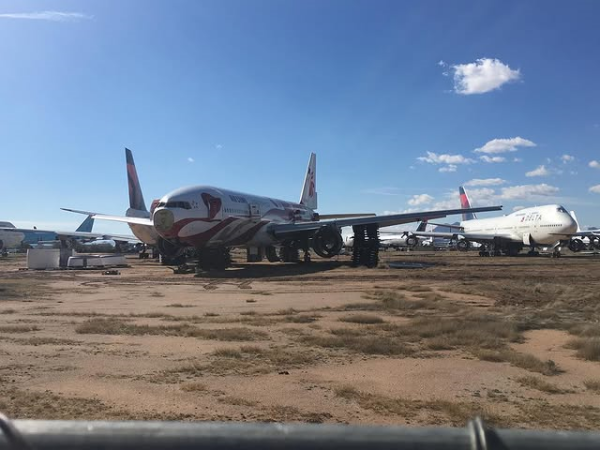


The plane entering the "graveyard" does not mean the end of the story, but often the beginning of the rebirth of value. The modern aviation industry has formed a highly specialized industrial chain that pursues maximum value in dealing with retired aircraft.
This process can be roughly divided into three stages: entrance, treatment and exit:
Step 1: Enter the "graveyard"-not just parking.
The plane will first fly to a large "airplane cemetery" like Davis-Monson Air Force Base in Arizona, USA.
But this is by no means a simple discard. Upon the arrival of the plane, a set of strict "hibernation" procedures will be implemented immediately to prepare for the subsequent processing:
Evacuation: Drain all liquids such as fuel oil and hydraulic oil.
Sealing: seal the engine inlet, exhaust nozzle and other openings to prevent foreign objects from entering.
Protection: the fuselage is sprayed with a special protective film, and the cockpit is covered with a sunshade to resist desert glare and sand erosion.
Disassembly and storage: remove high-risk or high-value components such as guns and ejection devices and store them separately.
Step 2: Core Treatment-Four Main Destinations
After pre-treatment, retired aircraft will go to four main destinations according to their own conditions and market value:
1. Storage and spare parts supply
Mode: This is the most common way to deal with it. In the "cemetery", planes are classified and managed. As a strategic reserve, those in good condition are ready to be re-used; Others, as "organ donors", were disassembled into parts.
Value: An airplane can disassemble about 350,000 parts. An engine in good condition can be worth $2 million, and the landing gear can be sold for $200,000-$500,000. These certified second-hand aviation materials are usually 50%-70% cheaper than new parts.
2. The whole machine is sold or modified
Second-hand resale: aircraft with short aircraft age and good condition will be resold to other airlines or freight companies, and will continue to fly for 10-15 years after "customer-to-goods".
Creative transformation: the whole machine was transformed into a restaurant, a hotel, a museum, a teaching aid, and even became the location of the movie Transformers.
3. Precise disassembly and material recovery
Mode: This is the most advanced environmental protection mode at present. The aircraft is finely disassembled by a professional organization.
Process: firstly, remove the high-value components, and secondly, remelt the aluminum alloy materials such as fuselage frame into aluminum ingots, which are used in the automobile and building materials industries; Finally, the composite material can become the filler of green building materials after treatment.
Results: The benchmark project of Airbus Chengdu Company has achieved 91% recycling rate of an aircraft, far exceeding the traditional model of 60%-70%.
4. Other special purposes
Test target: some retired military aircraft will be used as targets for live-fire exercises, making a final contribution to testing the performance of weapons.
Artificial reef: After environmental protection treatment, the whole machine sinks to the bottom of the sea to provide habitat for marine life.
New Trend: From "Cemetery" to "Life Cycle Service"
Nowadays, the trend is to regard the aircraft as a complete resource carrier, and consider how it can be better recycled in the future at the beginning of design. For example, the center set up by Airbus in Chengdu is the practice of this concept of "full life cycle service", which continuously improves the resource recycling efficiency of aircraft through the closed-loop feedback mechanism.